Showing posts with label Back to the Bible India. Show all posts

Monday, May 18, 2015

THE DONE UNDONE

THE DONE UNDONE
by Dr. Woodrow Kroll & Tonny Beckett

Psalms 148-150, 1 Corinthians 15:29-58 Key Verses: 1 Corinthians 15:55-57


You can't unscramble an egg. That simple statement reminds us that some things, once done, can't be undone. One noticeable exception is death. In the Resurrection, all that death has done was undone by Jesus.

Death's sting is sin. As the sting of a bee injects its poison into our system, so sin injects death into mankind. We die and our bodies decay. The power of sin is the Law because it shows us our sin and condemns us. We are guilty and sentenced to death.

Yet there is complete victory over death and sin through Christ. It is not that death is destroyed so that it cannot continue to harm God's people. But its effects are reversed so that death is defeated—and we will live forever, victorious.

The hope of the Christian is expressed by the epitaph Benjamin Franklin wrote for himself: "The body of Franklin, printer, like the cover of an old book, its contents torn out and stripped of its lettering and gilding, lies here food for worms. But the work will not be lost, for it will appear once more in a new and more elegant edition, revised and corrected by the Author."

The defeat of death, the hope of the Christian, is the resurrection of Jesus


Our hope is in Jesus, not just as a man of history, but as the resurrected Lord. Thank Him now for this truth, by which you are saved, by which you know that death is defeated Praise God! 

An adaptation from the book "Faith Walk" Written by  Dr. Woodrow Kroll & Tonny Beckett

Source: 
Back to the Bible Publishing, Lincoln, Nebraska.
Confident Living Magazine, Secunderabad, India.

Thursday, April 16, 2015

READ AND SUBSCRIBE CONFIDENT LIVING MAGAZINE

READ AND SUBSCRIBE 
CONFIDENT LIVING MAGAZINE
(An Official Organ of Back to the Bible)
(Read Few Pages From The Magazine)


Source:
Back to the Bible,
Confident Living Magazine

Monday, April 13, 2015

E is for Evening: Trouble in the Evening


Trouble in the Evening
by Dr. Woodrow Kroll
pic credit. www.allgraphic.com
The nations will rush like the rushing of many waters; but God will rebuke them and they will flee far away, and be chased like the chaff of the mountains before the wind, like a rolling thing before the whirlwind. Then behold, at eventide, trouble! And before the morning, he is no more. This is the portion of those who plunder us, and the lot of those who rob us.  Isaiah 17:13-14


What do Assyria, Babylon and the Roman Empire have in common? All of them, at one time or another, conquered Israel. Yet they share another commonality—none of them exists today as a nation. You will never get an Assyrian stamp in your passport. No one will every proudly announce to you, "I'm a Babylonian!" None of these once-powerful nations has survived into the 20th century—but Israel has. 


Throughout history men and nations have demonstrated their hatred for God's people. The Roman Emperor Diocletian is a good example. He issued an edict in 303 A.D. designed to annihilate the Christian religion and destroy the Bible. The emperor even built a monument on which were inscribed the words Extincto nomene Christianorum (The name Christian is extinguished). Only 25 years later, however, the emperor was dead, and the new ruler, Constantine, commissioned 50 copies of the Bible to be prepared at government expense.


Are you are facing persecution at work or school? Maybe people in your own family are seeking to discourage you from living out your Christian faith. God never promised that you wouldn't face these kinds of trials. What He did promise, however, was that ultimately those who afflict His people will fail. Your day of difficulties may seem long, but it won't last forever. Take heart? Morning is coming and when the sun rises, the night of despair is no more.


For every night of trouble, there's a morning of glory. 

Does Jesus Care?

Does Jesus Care?

www.aubeacon.com 
Then they came to Elim, where there were twelve wells of water and seventy palm trees; so they camped there by the waters.  Exodus 15:27

Almost a hundred years ago, a minister was plagued with ongoing trials and discouragements. When he thought he no longer could stand it, Rev. Frank Graeff remembered 1 Peter 5:7, which says, "casting all your care upon Him, for He cares for you." A new joy and peace encouraged his soul and he penned a song in which every stanza began with the question, "Does Jesus care . . . ?" The refrain echoes back, "0 yes, He cares—I know He cares! His heart is touched with my grief."

The Israelites had reached a point in their journey where they were asking, "Does God care?" There had been years of hardship in Egypt. Then there was the hard trek through the wilderness. Finally they came upon a campsite where the water was unfit to drink. Life was not easy, but at last God brought them to Elim, where the water was plenteous and the trees were lush and shady. In the midst of their adversity, God brought them to a place of relief.

Does God care about you? He really does. If you're going through a tough time, don't give up. God has an Elim in your future. Scripture promises that God "will not allow you to be tempted [tried] beyond what you are able" (1 Cor. 10:13). Ahead, at God's rest stop, there is rest for the weary and tranquility for the distressed. If you're at Marah, the water of bitterness, look ahead to Elim, the place of peace.

In His time, God gives us rest from every test. 

PS:  This is in continuation to the  A to Z Blog Challenge series for the Year 2015, These are written by Dr. Woodrow Kroll, Former President, Back to the Bible International.    

Due to some unavoidable technical problem we could not post on time.  —C L Team

Wednesday, October 29, 2014

ALL OF GRACE - Devotional Thought For The Day

ALL OF GRACE (Devotional Thought For The Day)
Theodore H Epp

EPHESIANS 2:1-10:
God dealt in judgment at Babel when He scattered the people and confused their language, but God dealt in mercy and grace as He called Abraham. Abraham did not receive God's call because he merited God's esteem. Rather, in God's foreknowledge He knew Abraham and chose him for a special purpose. God's election must always be traced to God's will and purpose. It is all of grace, for it is by God's sovereign choice.

Theodore H Epp
(Founder Back to the Bible)
It is the same with our salvation. If it were not for God's grace, we would be doomed to an eternity in hell. But notice what God has done because of His grace: "But God, who is rich in mercy, for his great love wherewith he loved us, even when we were dead in sins, hath quickened us together with Christ, (by grace ye are saved;) and hath raised us up together, and made us sit together in heavenly places in Christ Jesus" (Eph. 2:4-6). God did not do this for us because we merited it—it was while we were yet sinners that Christ died for us. It is important that we realize that our salvation is all of grace.

Abraham was not chosen because he was a special kind of person nor because he had a high 10 nor because he had great faith. It was totally of the grace of God that He called Abraham out of idolatry, and it is only of the grace of God that we have been called out to salvation.


But where sin abounded, grace did much more abound (Rom. 5:20). 

Source: 
Back to the Bible Intl.

Tuesday, July 29, 2014

In the End

In the End

by Woodrow Kroll

The prophets prophesy falsely, And the priests rule by their own power; And My people love to have it so.  But what will you do in the end?
                                   —Jeremiah 5:31 (NKJV)

Picture Credit: Google
Everything that begins also ends.  Beautiful buildings are erected, but eventually they are torn down.  Seeds sprout and grow into plants, but after their season they, too, come to an end.  Even the universe, as we now know it, will some day be destroyed (Revelation. 21:1).  It is only reasonable, then, that as we begin something we must keep in mind that  it eventually will come to an end—and then what?


That was God’s warning to Israel.  They were being misled by those who were responsible for their spiritual welfare.  The prophets and priests were telling the people only what they wanted to hear, which was fine with them.  They didn’t want to be confronted with their sins.  They loved the sugarcoated messages and the false assurances.  But God inquired, “What will you do in the end?”  What will you do when reality knocks on the door and you no longer can continue to deny the truth?  Everything that begins has an end—and then what will you do?


As you live your life, don’t forget that one day it, too, will end.  And then what? God’s Word indicates that all Christians must stand before the Judgment Seat of Christ to give an account of ourselves (Romans. 14:10; 2 Corinthians 5:10).  This is not to determine our salvation but the value of our works.  All those things that are built upon the lies of the world are only wood, hay and straw, and they will be burned up (1 Corinthians 3:12-15).  In the end, only what you have done for Christ will last.


As you go through your day, evaluate what you do in light of the end you know is coming.  When you stand before the judgment Seat of Christ, will the things you’ve given your life to really matter?  Commit yourself to do that which is of eternal value.


The end is coming—and then what will you do?


An adaptation from the book
 GIANTS OF THE OLD TESTAMENT: “LESSONS ON LIVING FROM  JEREMIAH

(A Back to the Bible India Publication, for more information please contact Back to the Bible India Office: @ Kanajiguda, Telecom Colony, Secunderabad - 500015, Phone. 040 27796353. Email. info@backtothebible.in or contact the blog admin: philip@backtothebible.in)

Source:
Back to the Bible Intl.
Confident Living Magazine, Secunderabad

Tuesday, June 3, 2014

Psalm 23: The Great Shepherd (A Commentary Note)

Psalm 23: The Great Shepherd
                           (A Commentary Note)
             By William MacDonald
The Lord is my shepherd; I shall not want.
2 He maketh me to lie down in green pastures: he leadeth me beside the still waters.
3 He restoreth my soul: he leadeth me in the paths of righteousness for his name's sake.
4 Yea, though I walk through the valley of the shadow of death, I will fear no evil: for thou art with me; thy rod and thy staff they comfort me.
5 Thou preparest a table before me in the presence of mine enemies: thou anointest my head with oil; my cup runneth over.

6 Surely goodness and mercy shall follow me all the days of my life: and I will dwell in the house of the Lord for ever. (King James Version)

The Twenty-Third Psalm is probably the best-loved poem in all literature.  Whether sung to the stately measures of Crimond or recited in a Sunday School program, it has a charm that is perennial and a message that is deathless.  “Blessed is the day,” wrote an old theologian, “when Psalm 23 was born!”

J. R. Littleproud’s outline is hard to improve upon:

The secret of a happy life—every need supplied.
The Lord is My Shepherd; I shall not want.
The secret of a happy death—every fear removed.
Yea though I walk through the valley of the shadow of death, I shall fear no evil; for You are with me.

The secret of a happy eternity—every desire fulfilled.

Surely goodness and mercy shall follow me all the days of my life, and I will dwell in the house of the LORD forever.

Verse 1.  Despite its world wide popularity, the Psalm is not for every9one.  It is applicable only to those who are entitled to say, ‘The LORD is my Shepherd.”  It is true that the Good Shepherd died for all, but only those who actually receive Him by a definite act of faith are His sheep.  His saving work is sufficient for all, but it is effective only for those who actually believe on Him.  Everything therefore hinges on the personal pronoun my.  Unless He is my Shepherd, then the rest of the Psalm does not belong to me.  On the other hand, if He is really mine and I am really His, then I have everything in Him!

Verse 2. I shall not lack food for my soul or body because He makes me to lie down in green pastures.

I shall not lack refreshment either because He leads me beside the still waters.

Verse 3.  I shall not lack vitality because He restores my soul.
I shall not lack moral direction because He leads me in the paths of righteousness for His name’s sake.

We smile at the youngster who panicked when reciting this Psalm and came up with the novel version, “The Lord is my shephered: I should not worry.”  But he was more right than wrong.  He missed the exact words but caught the exact sense.  If the Lord is our Shepherd, we need not worry!

Verse 4.  And we need not be afraid of death.  In the valley of the shadow of death there is no need to fear, because the Shepherd is right there with us.  The sting of death is sin—sin unconfessed and unforgiven.  But Christ has robbed death of its sting for a believer.  He has put away our sins once for all.  Now the worst thing that death can do to us is really the best thing that can happen to us!  Thus we can sing:

 O death, O grave, I do not fear your power;
The debt is paid.
On Jesus in that dark and dreadful hour
Our sins were laid.
—Margaret L. Carson

It is true that Christians may have a certain foreboding about the suffering that so often accompanies death.  As one old saint was overheard to say, “I don’t mind the Lord taking down my tent, but I hope He takes it down gently!”
It is also true that we usually do not get dying grace until we need it.  But the fact still remains that death has lost its terror for us because we know that dying means going to be with Christ—and this is far better.

“To die is gain.”

The Shepherd’s rod and staff are source of comfort, protection, and guidance.  Whenever necessary He may use the rod for correction also.  Most sheep need this ministry from time to time.

Verse 5.  In the meantime, the Shepherd prepares a table before us in the presence of our enemies.   On the table are spread all the spiritual blessings which He purchased for us with His precious blood.  The table pictures everything that is ours in Christ.  Though surrounded by enemies, we enjoy these blessings in peace and security

J. H. Jowett illustrates:

Eastern hospitality guarantees the security of the guest.  “All the hallowed sanctions of hospitality gather around him for his defense.  He is taken into the tent; food is placed before him, while his evaded pursuers stand frowningly at the door.”

He also anoints our heads with oil.  Shepherds anoint the heads of their sheep to soothe the scratches and wounds.  For priests the anointing oil speaks of consecration to their work.  For Kings the anointing oil is associated with coronation.  Every believer is anointed with the Holy Spirit the moment he receives the Savior.  This anointing guarantees him the teaching ministry of God the Spirit.


When we think of all the riches of grace which we have in Christ Jesus, we burst forth with the grateful acknowledgment, “My Cup runs over!”
His love has no limit,
His grace has no measure,
His power has no boundary known unto men:
For out of His infinite riches in Jesus He giveth, and giveth, and giveth again
—Annie Johnson Flint

Verse 6.  Finally there is the secret of a happy eternity.  Escorted through all of life by God’s goodness and mercy, we reach the Father’s house at last, our eternal dwelling place.  As we think of it all, we have to agree with Guy King when he said, “What lucky Beggars we are!” CL


(An adaptation from “BELIEVER’S BIBLE COMMENTARY” 

by William MacDonald.)


This commentary is now available from the office of Back to the Bible, Secunderabad  for a donation of Rs. 1300/-(Including Packing and Postage) 

PS: 
To Read an article by the same author please click on the below link:  The Temple of God


Monday, May 26, 2014

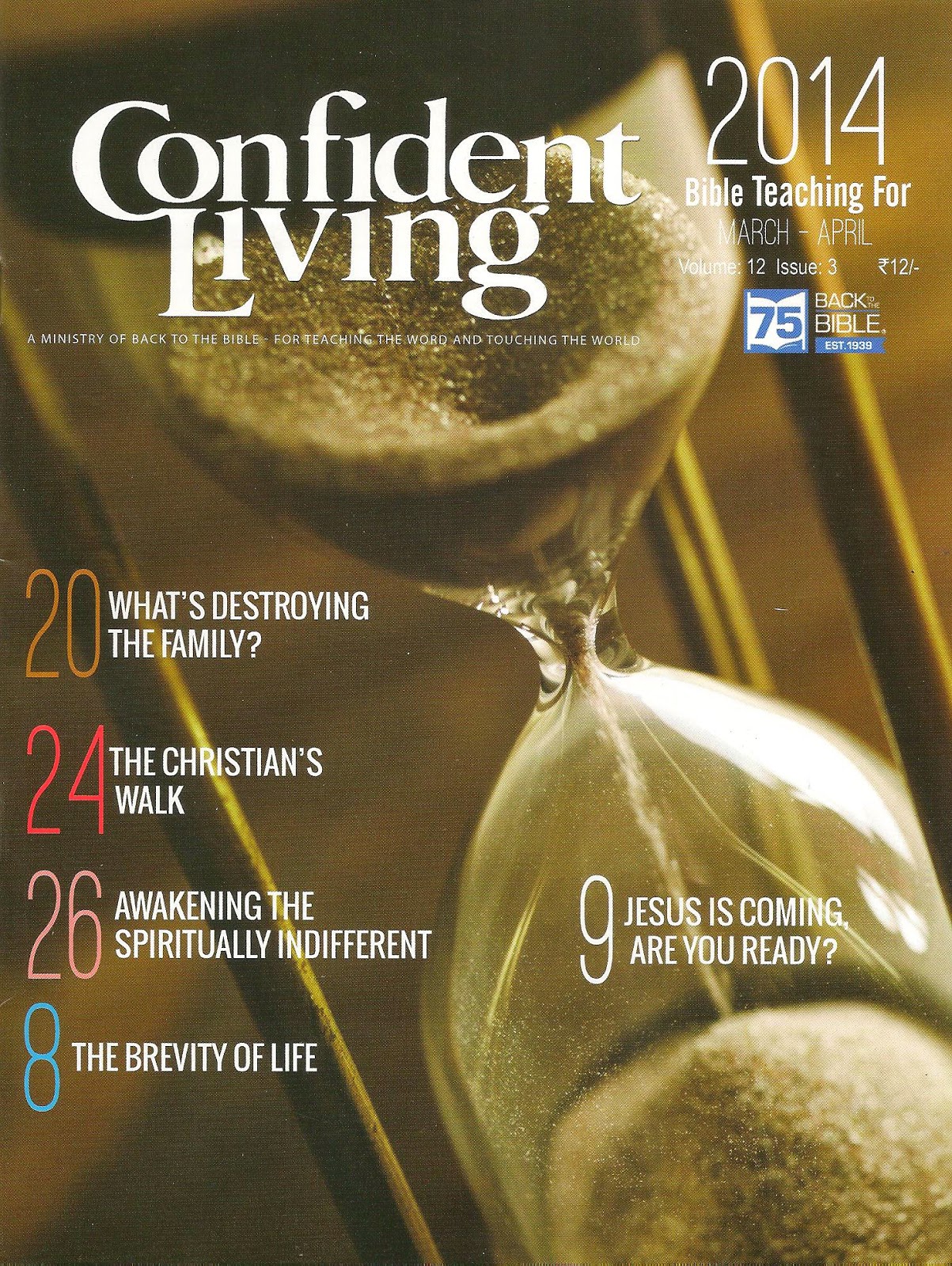
Confident Living Magazine Current Issue


READ AND SUBSCRIBE CONFIDENT LIVING MAGAZINE
THE OFFICIAL ORGAN OF BACK TO THE BIBLE INDIA MINISTRY

TO READ THE ARTICLES PLEASE CLICK ON THE PICTURES.